Showing posts with label Horses. Show all posts

Wednesday, October 27, 2010

Peralli Horsenality™

Horsenality™ is something that Pat and Linda Parelli developed to help you better understand your horse’s individual behavior and temperament characteristics. Usually I don't say I train this certain style or that certain style. I generally borrow from whatever seems to work the best for the particular situation. I did find this chart neat to look at and fun though.


To identify your horse's "horsenality," consider every trait listed on the chart and make a dot on the specific ring that best corresponds to your horse. For example, if your horse is extremely playful, you would put a dot on the outer "extreme" ring under this trait. If he is non-responsive, but only some of the time, you would put a dot on the middle "moderate" ring by this trait. Some of the traits may not apply to your horse at all. You can have dots in different quadrants, but the vast majority of horses will end up with most of their dots in one quadrant, which reveals that horse's Horsenality.  Basically there is four categories.

The Right Brain Extrovert needs safety. Never push him past the threshold until he's calm. You will need to retreat and to interrupt the pattern. You must have a strong focus and must match the horse's high energy level. Give him a job to accomplish to replace his fear with something positive. He must think of you as his "safe place."

The Right Brain Introvert needs comfort. The worst thing you can do is push this horse before he's confident. You'll ruin his trust in you if you push him before he's ready. Taking your time is important because you'll need to wait on this horse to process things. He needs to believe in you.

The Left Brain Extrovert needs play. He craves creative, imaginative tasks and can't stand to be forced into anything. Because he hates to be bored, you'll need to speed things up, be enthusiastic and come up with variety in your lessons. Allegro falls into the Left Brain Extrovert category.


The Left Brain Introvert needs incentive. There are plenty of ways to offer incentive without "bribing" him. (Think rest, grazing, treats, scratches.) This horse needs to have a purpose and wants to go somewhere. Riding circles in an area with this horse will lead to resistance and defiance. Use reverse psychology for best results.


For more information about Horsenalities, visit www.parelli.com

Saturday, September 25, 2010

The real Wild Horses I

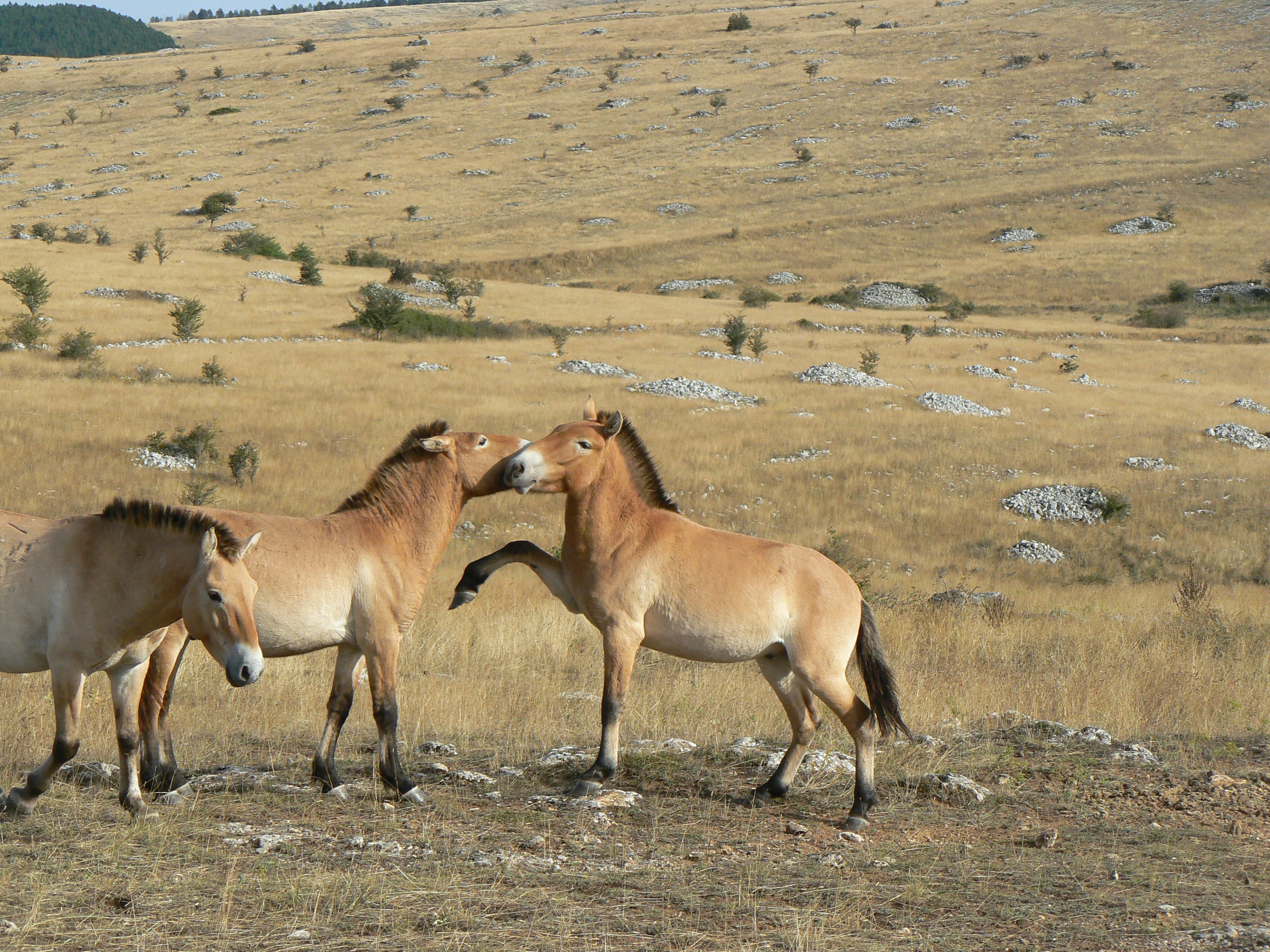
I think I've made it fairly clear that American Mustangs aren’t actually wild horses and are actually feral horses descended from domesticated animals that escaped and adapted to life in the wild. There is a few known surviving wild hoses species today one of which is Przewalski's Horse. Unlike the American Mustangs, Przewalski's Horse has never been successfully domesticated and remains a truly wild animal to this day. Other wild equines, include three species of zebra and various subspecies of the African wild ass, onager and kiang.

Przewalski's Horse occupied the eastern Eurasian steppes, perhaps from the Urals to Mongolia, although the ancient border between Tarpan and Przewalski distributions has not been clearly defined. Przewalski's Horse was limited to Dzungaria and western Mongolia in the same period, became extinct in the wild during the 1960s, but was re-introduced in the late 1980s to two preserves in Mongolia. Although researchers such as Marija Gimbutas theorized that the horses of the Chalcolithic period were Przewalski's, more recent genetic studies indicate that Przewalski's Horse is not an ancestor to modern domesticated horses.Przewalski's Horse is still found today, though it is an endangered species and for a time was considered extinct in the wild. Roughly 1500 Przewalski's Horses are protected in zoos around the world.


A small breeding population has been reintroduced in Mongolia.As of 2005, a cooperative venture between the Zoological Society of London and Mongolian Scientists has resulted in a free-ranging population of 248 animals in the wild.Przewalski's Horse has some biological differences from the domestic horse; unlike domesticated horses and the Tarpan, which both have 64 chromosomes, Przewalski's Horse has 66 chromosomes due to a Robertsonian translocation. However, the offspring of Przewalski and domestic horses are fertile, possessing 65 chromosomes.


Conservation Staus:

Critically Endangered (IUCN 3.1)


Przewalski's Horse is stockily built in comparison to domesticated horses, with shorter legs. Typical height is about 13 hands (52 inches, 132 cm), length is about 2.1 m (6 ft 11 in). They weigh around 300 kilograms (660 lb). The coat is generally dun in color with pangare features, varying from dark brown around the mane (which stands erect) to pale brown on the flanks and yellowish-white on the belly and around the muzzle. The legs of Przewalski's Horse are often faintly striped, also typical of primitive markings. The tail is about 90 cm (35.43 in) long, with a longer dock and shorter hair than seen in domesticated horses.


Where are they? The world population of these horses are all descended from 9 of the 31 horses in captivity in 1945.These nine horses were mostly descended from approximately 15 captured around 1900. A cooperative venture between the Zoological Society of London and Mongolian scientists has resulted in successful reintroduction of these horses from zoos into their natural habitat in Mongolia; and as of 2005 there is a free-ranging population of 248 animals in the wild. The total number of these horses according to a 2005 census was about 1,500.


Other names for Przewalski's Horse:

Equus ferus przewalskii
Mongolian: Тахь
Takhi
simplified Chinese: 野马
traditional Chinese: 野馬
 Yěmǎ
Dzungarian Horse

Friday, August 27, 2010

Beginning Trick riding

I've always wanted to learn how to trick ride and when Allegro matures and grows some more (I'm think when he's around 5 years old) I'll see if I can get a trick riding deal going with him. I just started practicing with other horses. I have not yet tried with Allegro because I don't think he would be able to handle the weight distribution. He only barely old enough to ride as it is.

Here are some photos of me practicing on my sisters horse!

I don't have an actual trick saddle (they're expensive!) but this pleasure saddle seems to be working well for the moment. These pictures are only done on a standing horse although I did try to do some of them and other moves on a horse with some speed.
I found with a different saddle with a lower pommel I could leverage my leg so that my left leg didn't have to be in the stirrup but I couldn't close my knee enough around this one to do that.


This is my favorite move so far. For a dismount I let my leg continue over my head and flip upright letting go of the saddle.

Again I don't really know anything about trick riding I was just going with what seemed to come easy and balance well. Hope you like the pictures!


Thursday, August 19, 2010

Mustang digital drawing

A horse is a thing of beauty; none will tire of looking at him as long as he displays himself in his splendor.


-Xenophon


A picture drawn on Photoshop CS3.

I was inspired to try and draw a mustang as digital art.

 Horses are a wonderful art subject! Whenever you go to a sales room, maybe with a horse show or rodeo or some other horse event, there's almost always a few vendors set up selling artwork or prints of horses. I've always been blown away by some of that art. It can be simply breathtaking!

The picture turned out rather well, although I think I may go back and add in a stronger outline.

Notes on this picture:

I used the heavy brushes mostly and then either blurred or smudged them for the body part and coloring. The mane I first drew in entirely black and the used the smudge tool to reconstruct how I wanted it. I used another layer for the pastel colors over the picture with a low opacity. I used a "underpaint" filter on the entire picture except the mane and the outline.
Just if anyone is curious...

Wednesday, August 18, 2010

Jumping pictures


Because our camera is so slow these were not actually taken back to back but were from multiple jumps. I just arranged them so you could see the progression. =] Enjoy!

Friday, August 13, 2010

30 days


This competition is about 100 days long and we're at (roughly) day 30.

Rachel has been trying to make the best of time so far, which requires a lot of work and dedication on her part. She's doing a fine job. And it's really neat for me to see her use what she's learned in the past on this horse and to see her growth as a trainer and horseman. I'm certain she will learn a lot from this too. The intensity that she puts into is such that she wants to spend hours working her horse everyday. Teaching a horse from the ground up when it has no knowledge of what we consider training is a great process, and different than working with a domestic horse. With that kind of focus on your skills it's really difficult not to learn something.

Although we have noticed some problems that will need to be fixed most of it is coming smoothly. Rachel is really enjoying the experience but it definitely is challenging, and at some times very stressful.

Rachel and Big Mak explore the possibilities of a feed trough.